What it is for
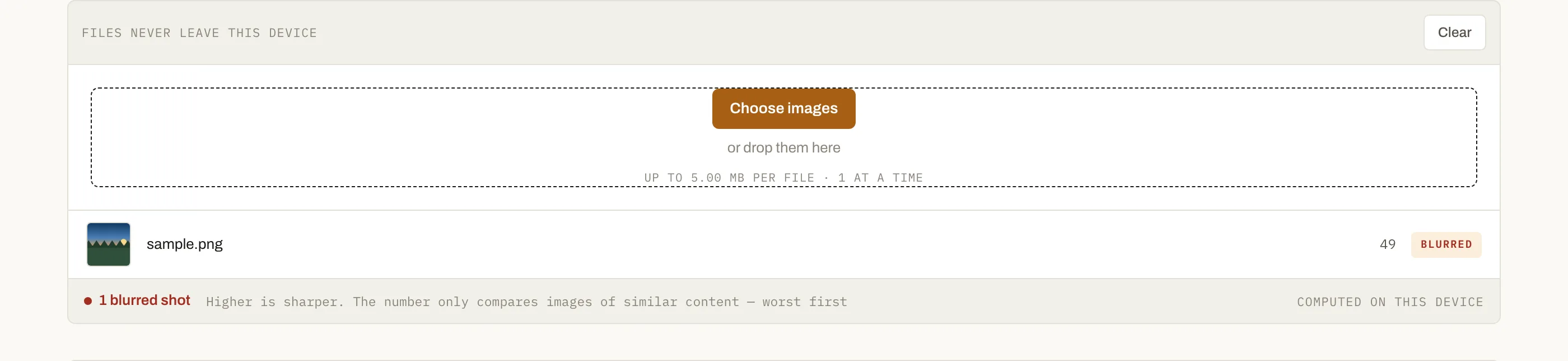
Triage. After a shoot or an event you have hundreds of frames and a handful missed focus. Sorting by sharpness puts those at the top of the list so you look at them first, instead of scrolling through everything at full size.
It is a filter, not a judge. The output is an ordering worth reviewing, and the review is still yours.
Why the number is relative
Sharpness scores measure edge contrast, and edge contrast depends on the subject:
| Subject | Typical score, in focus | | --- | --- | | Text, brickwork, foliage | very high | | A face against a busy background | high | | A face against a plain wall | moderate | | Fog, snow, a plain sky | low |
A sharp photograph of a plain wall can score below a blurred photograph of a newspaper. That is not a fault in the measure — it is why the comparison has to be between similar images.
What blur it cannot tell apart
Missed focus, camera shake and motion in the subject all reduce edge contrast and all score the same. So does an image upscaled from something smaller, which is occasionally the more useful finding — a low score on a large file often means someone enlarged a thumbnail.
Questions
How does it decide?+
Variance of the Laplacian — a standard sharpness measure. The Laplacian responds to abrupt intensity change, so it is large at edges and near zero on smooth gradients. A blurred photograph has no sharp edges, so the spread of that response collapses.
What is a good score?+
There is no universal threshold, and any tool claiming one is guessing. The number depends on content as much as focus: a picture of a brick wall scores far above a portrait against a plain background, both perfectly sharp. Compare images of similar subjects, and treat the bands as a first pass rather than a verdict.
Why is a deliberately shallow depth of field marked as blurred?+
Because most of the frame is out of focus, which is exactly what the measure detects. The tool cannot know that the blur was intentional. For portrait work, judge the flagged images yourself rather than deleting on the score.
Does it resize before measuring?+
Only down to a 900 px box, and only for speed. Downscaling further would smooth away the very detail being measured and make every image look sharp.